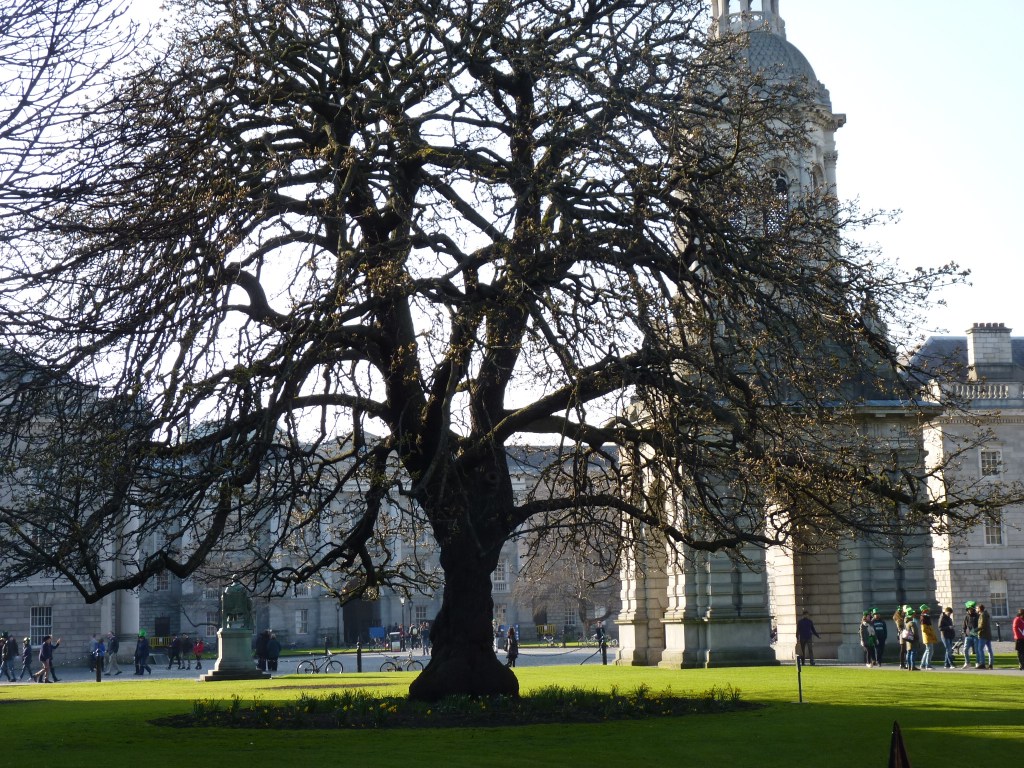
I landed in Ireland two hours ago. The sky is grey but isn’t raining. I wander in unknown streets and try to get warm with a cappuccino in the “the” coffee shop where you should have a coffee and I don’t even like coffee. I try to feel Ireland’s past. Here, one day, a long time ago, there were Vikings. They even built the city. Today, what is left of them?
This thought brings me back to another past, to another place. I’m in Paris, five years ago, standing in front of the Mur des Fédérés in Père Lachaise Cemetery. It is cherry time, it’s time of red suns hanging on your ears, it’s May 28th, last day of the Bloody Week, when the last Communards rebels were shot in front of that wall. At that moment, something hit me: if other dimensions of the world exist, if every layer of the past lies under the layer of present times, I am with them now. I can hear them die.
It is the reason why I’m in Ireland today, to walk the Irish layers of the past and blend them with my present so I can write Irish history on stage. I want to sink into Ireland, land of music and words, through its ground and words. Therefore, I tune my readings and create another timeline in another time’s reality. I superimpose places and presents. And like a nice serendipity, Ireland follows my lead: I am here for the first century anniversary of the Easter Rising.
April 24th – 1916, Ireland Independence Proclamation signatories read their declaration of freedom in front of the General Post Office. A small crowd listens but most of the pedestrians don’t really care about those few rabble-rousers. Yet, this speech starts a week of urban guerrilla and a seven years process that will change Ireland forever.
Inspired by the legendary hero Cu Chulainn, leaders fight a war that they cannot win for the symbol and for the next generations. Half mortal-half god warrior, Cu Chulainn fought all the Five Kingdoms wars and stands for his last battle his guts in one hand. Fatally injured, watched by Morrigan raven, he ties himself to a rock and waits for the last round because glory is longer than life. Thus, he protects his army and gives a chance to Red Branch Warriors to win that war. The Easter insurgents will fatally die as well, but they’ll die for Caitlin Ni Houlihan’s love*.
The Easter Rising doesn’t reach the rest of the island like it was planned, it gets locked within the capital’s walls. And Dublin definitely doesn’t know on which side stand. The insurrection strikes Irish people like a lightening, in the middle of the First World War, they don’t expect such a mess, they don’t want it. The uprising is absolutely unpopular, people fraternize with English soldiers sent to bleed that umpteenth revolt. And from the French trenches, Irish soldiers feel this rebellion like a treason: indeed, some have decided to fight in the British side so the war would end more quickly and Home Rule would finally be established as the British government promised. Most of the civilians, conflict’s inevitable collateral victims, don’t want to be linked to those “traitors”; on the other hand, some furiously join the rebellion. Some Abbey Theatre actors for instance, choose to play another part than the one they should play on stage: they become Easter warriors. Sean O’Connelly, National Theatre of Ireland actor, will be the first to kill and the first to die. First, but not the least of this bloody Easter. Small boys don’t believe that people really kill them, but small boys were killed. **
After too many civilians death, leaders surrender to the British Army’s massive artillery. Booed and harassed by the people, they are sent to Kilmainham Jail and condemned in martial court. After their violent, and often unfair, executions, the opinion switches side and stands with the rising. Insurgents, now martyrs, become the symbol they fought for and make the first step towards the unstoppable independence of Ireland.
My feet already get impatient to walk streets, hills and ports. My heart already flinches, hungry of writings and readings. For the first time, I give myself the opportunity to be fearless and excessive, without worrying about the future. Far from my life that I turned into a prison without knowing it, all my dreams are now free.
Suddenly, the jukebox stops and breaks my thoughts, I feel completely naked, as if the music preserved me from the world, from the idea of others around me. I feel revealed by the silence of the Irish speaking of their lives. It’s only closure time, time to leave and experience my first night at the pub.
It’s Sunday and I take time to lose my time. I wander, get lost, eyes on my shoes, and find my way without knowing the streets. I watch a spinner spinning the wool on her antique spinning wheel. I plant some potatoes so I can feel Ireland to its oldest roots. And I listen to Carol and Thorsten, my hosts in Cork, telling me their Ireland. Her Irish childhood. His German exil.
She shares her memories, her random thoughts, her childish mythology; she wants to give me every Ireland’s inconsistencies. She points out her country’s nonsense: old institutions stuck in the past in front of very young and active people. Yet, some part of Irish history were freer than today: Brehon Laws were much more modern, especially about women’s rights. Of course, new Ireland chose to get inspired elsewhere! In 2016, and only since 2013, abortion is authorized if, and only if, pregnancy puts the mother in moral or physical danger; others – young, single, raped, or not ready –, don’t have any other choice, for those who can afford it, than crossing St George channel like millions of women throughout the world. Indeed, the right of the unborn child in the Irish Constitution never prevented thousands of women over time to reach England or to use knitting needles in order to get rid of their unwanted burden, with tragic consequence for most of them to die creating life.
Carol also tells me about unspoken family issues, mostly related to Irish wars. When she was a kid, she heard about the Northern “Troubles” but from Cork, it seemed to be so far from her. In her family, there is a mystery about that. Nobody talks about her grand-parents’ life during the Troubles, and I get confused, I can’t tell if she is talking about the Northern or the Civil War, both of them being named Troubles in Irish vocabulary… No matter if she speaks about the troubled period in Northern Ireland or in Southern Civil War, Carol raises her voice: people always talk about “troubles” because they wouldn’t dare to call it a war. And my mind builds bridges throughout history: these two events are related, one is the extension of the other, or more accurately a shrinking in space of the other. A civil war not at the island’s scale but focused in one province and its delimited cities.
The “first” Civil War sneakily started in 1921, when half of Ireland didn’t agree with independence conditions dictated by the British Crown. The whole Nation knows the Treaty is not enough, it’s only the first step. In fact, Michael Collins will say about it: “In my opinion [the treaty] gives us freedom, not the ultimate freedom that all nations desire and develop to, but the freedom to achieve it.” But people can’t get along on how to get the ultimate freedom: Pro-Treaty militants know that Ireland, tired of two years of War of Independence with the British Empire, wouldn’t survive more battles; Anti-Treaty, in the other hand, can’t stand to lower their ideals.
Right or wrong, two more years of guerrilla follow, during which Irish people shed Irish blood. When Anti-Treaty combatants surrender in 1923, the new Irish Free State abandons Ulster Catholics to the angry Protestant Province. It’s one of the Treaty terms: Ulster is free to decide for itself and the Protestant majority has, in 1921, expressed its allegiance to the Commonwealth. Thus, internal war only ends on the southern part of the island, the North quickly fights an endless war that nobody will ever call a war. Troubled North is the child of the Civil War disaster, not utterly defeated but helpless.
Thankfully, Thorsten gives me a lighter look on Ireland that he has discovered throughout marriage. He observes its weird habits with a smile in the eyes. There was a time when Irish were not allowed to go to the pub on Sunday night after a certain time, except if they were traveling. Therefore, people went to the closest village to have a pinte and so on, everybody was now traveling.
* Mythical symbol and emblem of Irish nationalism found in literature and art, Caitlin ni Houlihan sometimes represents Ireland as a personified woman
** Patrick Pearse
 Fleeting Wor(l)ds