My French life and my professional issues break my brand new world for a second though, even if I cut every internet and mobile connection towards me. Panic strikes me, but I immediately and absolutely cling to the present. An unknown present full of Irish and comforting music, a present which might be my own flight… Never mind! I’ve been courageous before, if I need that escape to put distance between my soul and my reality, I’ll take it for a couple of weeks.
I run away to Blarney Castle then, built by Mac Carthy family, one of the oldest in Ireland since they claimed to have been converted to Catholicism by St Patrick himself! The castle undergrounds would have made an escape towards Cork and Kerry, co. on Cromwell’s approach in 1649.
October 23rd 1641, Ireland hammers its insurrectional song. Born in Ulster not totally slaved yet, the political rebellion soon turns into a genuine popular uprising after the usual extremely violent English responses. First, rebels only want a calm and peaceful rebellion, but the more peasants join the battle, the less the leaders can tame their troops.
Atrocities replace the initial mercy, Catholics lead a furious revenge for the giant confiscation they just suffered. No – holy or not – man, no woman, no child, all Protestant, is spared. Some are drowned, others hung. Entire families are sent back to their burning homes. Some who’d be sworn to be spared are put to sword. Some minsters are even crucified despite priests standing for their safety. Ireland is a burning land. This atoning violence leaves a permanent marks in Protestant’s memories, only matched by infuriated Cromwell’s savagery when he and his troops break the resistance and annihilate any idea of a Nation on the wild island; monstrosity imprinted in Catholic’s memories as well.
However, in 1642, Protestant and domineering England has to reckon Catholic and abused Ireland. Plagued by its own civil war, the Old Blighty could almost have changed the course of history by freeing its first colony. Indeed, the Confederation of Kilkenny just structured the rebellion and united people behind an Irish and Catholic government, which led the Easter Rising leaders to consider that beautiful independence promise as the first major Irish Revolution.
But the King of England loses his head and the English devil’s messenger lands on the Irish upraised shores, slaying women and children who took refuge in Drogheda church, shedding citizens’ blood on Wexford’s barricades, streets and squares and spreading on his way piles of dead on the top of the piles of dead that he promised when he landed. A few other massacres later, Irish people only have one choice left: Connach or Hell! They’ll choose the Western lands, barren and rocky, cut from the hinterland by Shannon River and lakes: a native reserve easy to control when the rest of the island stays in English greedy hands. As for Hell, two choices: terrible swift sword or deadly transportation.
I understand better why Blarney Castle lords, well-known speakers, chose the flight over the bargain for their life…
However, Blarney Castle didn’t only take part in the tormented island history, it stands along the mysterious druids, witches and myths era; trees and little stones circles can tell. Except there are hundreds of tourist trying to catch the mystery with me and it loses a bit of its magic. Thankfully, the crowd piles up in the tower ruins, trying to kiss the Blarney stone, when I’m hiding in the forest nearby. I try to guess druids’ secrets in their stony hut protected by the Three wise men.
Everything moves me so strongly here. Everything seems to be shinier, more intense, everything irredeemably goes through me. I feel like I’m aware of every single thing, every daily event. Like what happens the night before St Paddy’s day: I’m back from Blarney and having a pint in the HI-B pub, when one of the regulars leaves singing We’ll meet again… And all the other costumers sing with him. And I sing with them tears in my eyes. It’s like I have reconnected my heart to every small nerve, like I didn’t have to be defensive anymore. Like I was free to be somebody I forgot I was. Like I was able to be me again. And I hope I’ll be able to bring that little piece of how I am here home with me.
Because I know my foreign language is responsible of this new slowly gained freedom. English words doesn’t sound the same, they feel less heavy on my heart than the ones I would say in my mother tongue. And as I free my speech, I free myself as well. I feel free to lightly think of tomorrow, I genuinely trust life, I believe everything is possible. I can feel this trip is changing me and I enjoy it without knowing how or why. I let myself be driven by seas, crossroads and winds.
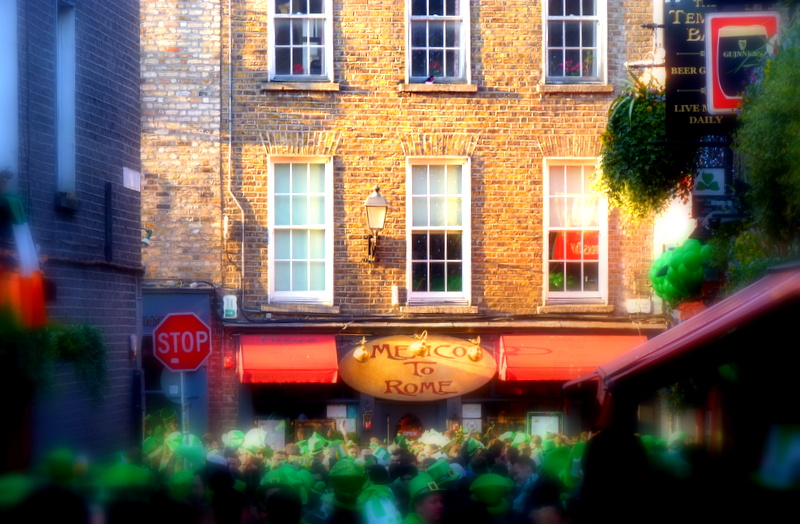
My father joins me for a few days and we share a small piece of Ireland together, on the edge of a Murphy or a Guinness. Time for a small St Paddy’s escape in Dublin as he wears his Saint Irish hat all day long, time for a beer contest that I cheerfully win, time to talk about life, Ireland, us, everything, anything but never nothing; and it’s already time for him to go back to France, for me to go back to my lonely steps. I hide my tears, keeping them for another time, for another departure, for another pain.
After seven days in Ireland, I painfully leave Carol, Thorsten and their comforting world, I leave Cork that I know better and where I could walk blind if cars were not driving on the wrong side of the road. Green western winds and Myths called me to Ireland and in Cork, I felt in a reality that I know. It was a slow start and, if I enjoy every Irish taste, it’s now time to melancholically reach the Atlantic.
I get to Limerick where everybody discouraged me to go: known as Stab City, the place got really bad press because of the criminality. But before bladed weapon war, Limerick was the Viking base to plunder Ireland; Limerick was a symbol of Irish resistance, to Cromwell (who crushed it after three months of siege) and during the Williamite War in Ireland.
James the Catholic is overthrown by his nephew and son-in-law, William of Orange, much more Protestant, much better seen in English Court. Of course, this war between two KinGs of two different religions finds its way in divided Ireland, feeding tensions between Anglo-Irish Protestants and Irish Catholics. Limerick staged that war: the city is besieged by Organists after James’ defeat during the Battle of the Boyne. Patrick Sarsfield leads with passion his Wild Geese, Jacobite resistance soldiers, and makes a deal for Catholics in Ireland in 1691. But the Treaty of Limerick is denied by the Protestant government in Dublin, which will, instead, harden a bit more their already stolen life, by creating the horrid and unfair Penal Laws, enforced for the three next centuries.
The wild and rebel geese prefer to flee in absolutely overwhelming conditions than to surrender. Boats are too small to held Jacobite soldiers and their family, therefore, once men have boarded, ships cast off. Husbands call for a mutiny, children and wives hurry on the quays so they are not left out, some women even cling to the vessels’ ropes. The more stubborn will see their fingers cut, others will drown in front of their helpless husband and kids. Limerick is only a long and terrible keening of sacrificed families in a devastated country.
Today, centuries later, the tragic mourning has left, but both my heart and Ireland are grey. I don’t know if it’s the city’s foggy feeling or negative forewords, or my dad’s departure, or maybe my solitude; but my heart is full of melancholia. I hope a good and strong cup of black tea will help me out… I pray for some warm sunbeams on Shannon River, because sun has left me and with it, all my happy promises.
In this exact moment, as if my thoughts needed to be broken, like a fragile hope for my tormented soul, a small sunbeam pierces the window, softly warm my ear through my hair curtain, and disappears just giving me time to write it down. Fleeting light for my freezing hands and my painful feet. So I put music in my ears, wool around my frozen body, take out my travel diary and write, or my book and read Edna O’Brien’s life; to break the curse, to make my own luck, and warm up my cold heart and room.
The day started so well yet, despite Limerick grey and cold sky. The Milk Market was full of life, music, people and smells, portend of beautiful walks to come. Every possible was freed by my solitude. But I almost got lost and bored in sad and desperate streets.
 Fleeting Wor(l)ds