However, every place has a story, an inheritance, a weight on the chest, and worth to be seen, even for a couple of hours. Limerick tries its best to get out of its industrial town cesspool abandoned to the muddy swamps, to get some pieces of life lost throughout dark years. The city tries its best to defeat its nasty trauma, to heal from the worst war people had to fight, a war against a vicious and invisible enemy. Kids were dying in Limerick mud since the beginnings of times. Kids were dying because of poorer districts insanity. And they flew like Angela’s ashes, and they might still wander, endlessly, in their early death limbos. The city only remembers them with a stone for the dead children printed with a newborn cheeky little feet.
Something is completely upside-down inside me, I feel like I’m passing by ghosts without really meeting them. A heavy and bitter melancholia steals my being. Limerick doesn’t suit me at all, or I don’t suit Limerick. Is the city darkening my heart? Does my mood drown it into despair? We can’t understand one another, but life rises with the sunset and hope explodes with the night. Maybe in some warm pubs, fleeting Irish encounters will bring some light joy in my demoralized day.
I’m finally sailing to the Aran Islands, my Irish Promised Land. But before, I stop in Ennis. I wander for one hour throughout the sleeping town under a cloudy and unbreakable sky. The church bells rings and life slowly awakes. One walker. Then two, then three. A crowed mob enters the grey morning through the wooden church doors. Life can begin since God wants it. They communed, they cleared up their little and big sins.
I’m driven across County Clare winding roads and enjoy my Irish cliché: green fields parted with small stony and old walls. And sometimes, grazing sheep within. And sometimes, a ruin of a wall, a castle or a tower within; only remembrance left of a hidden past. A few forgotten ghosts might probably still wander trapped into stones. I welcome those little longed and naive dreams.
I land in Cill Ronain and like Synge, I’ve never seen such a barren land; the grey pier, dark rocks in the distance, everything looks so dismal. Haze in my only haven since everything is hazy: Irish land, clouds, sun, horizon between sky and sea. I feel like in a blurry dream.
And I spend my afternoon getting lost in thirty one square kilometers. I’m looking in vain for the Fairies’ entrance but they abandoned me. I’m looking for a special door to the Otherworld, the one people believe to be Diarmuid and Grainne’s bridal bed during their mythological and distraught flight. Grainne, young woman promised to Fionn Mac Cumhal, the already old leader of the Fianna warriors, falls in love with Diarmuid, one of these warriors, the most handsome of course. On her defense, Diarmuid has a love enchanted spot that makes him irresistible to any woman. Despite his great sense of honor that helps him resisting to the enamored woman, Grainne uses a very old Irish magic: the geis, idiosyncratic taboo whether of obligation or prohibition. Violating a geis is a more deadly curse than betraying his chief, thus, they run away together, inextricably bounded by fate and magic. Fionn’s revenge follows them during seven years, they run across Ireland and never stay more than one night in the same place, leaving behind them the bed they built under a dolmen everyday. The cursed lovers would then have stopped in Inis Mor, but I can’t see their flight’s remains because I get lost.
You can wander without a goal, but not when you don’t know from where you come, to where you go, because then, every way could be the one. Because then, you can’t guess if you are progressing or retreating. And in front of the unknown, you make a choice, you drown maybe in the wrong place but you persist, hopping you’ll come stronger out of it. And it’s what I’m doing, I experience an intense freedom on the top of that volcanic garden as I’m looking for the running lovers’ haven; but, lost, without goal nor hope, my fleeting certainty already blown, I’m in Hell, an infuriated watchdog prevents me from crossing, I have to go back to where I’m from. I’m back on the main road; without any sign to guide me, I realize I have almost stood by… Sky turns now to night, I have to go home and I haven’t seen a thing, I wasn’t meant to feel the endless and deeply moving lovers’ flight today.
Thankfully, on my way back, I pass by a native couple; I gaze, stunned, the woman crossing herself when she meets me. I wonder if I turned into the devil being so close to Hell. I finally glance the Holy Virgen hidden in the stone behind me. I couldn’t see the Dolmen buried in the island’s heart, but I saw that woman who can’t pass by a cross, a Virgin or Jesus without, for a few seconds, sending her thoughts to God. My missing stony bed doesn’t matter, that unassuming and devout woman is the island’s gift for today. I have to take it and allow myself to be led by fate.
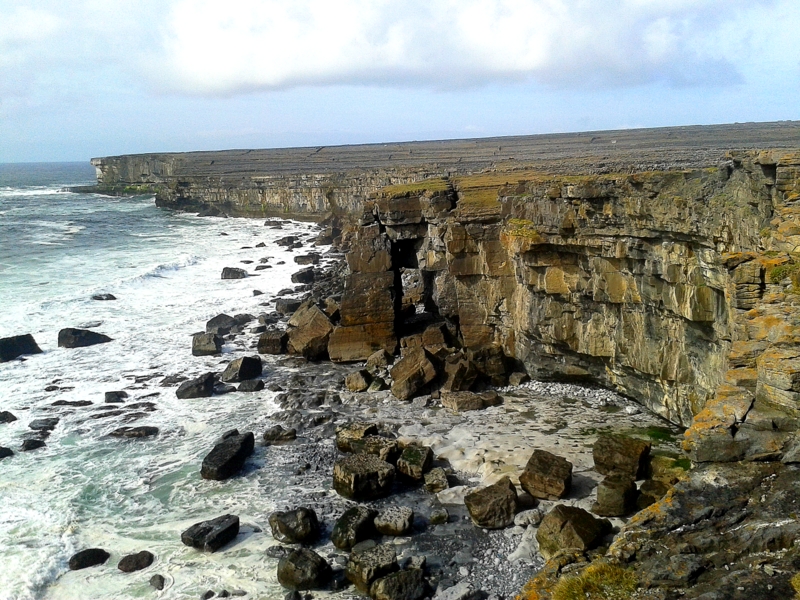
I wake up with the first lights and, before escaping to the smallest island, I seek for more of Inis Mor. I’m getting closer to Dun Duchatair and can finally hear the wild ocean. In front of that endless blue world, I can understand how people used to think they lived on the edge of the Earth, alone in the whole planet. And I taste every second of that fleeting feeling of being utterly complete. I’m already so moved, when the next landscape is even more stunning and deserves a better elegy.
It’s so huge. So rough. I’m standing between the sharp island and ocean. The unexpected and yet hoped cliff makes me drown, I’m facing perditions which ate so many fishers by sea, so many travelers on earth. I understand now knitwear’s stories: on Aran Islands, each family had its own knitting stitch and when fishers buried in oceans came home, brought by the swell weeks after they had disappeared, stitches were the only way to recognize the dead. Water had been so mean and hungry because of some fallen angels with Lucifer: spared before having completed their fall, they would still be hanging in the air, belonging to no world, neither Hell nor Heaven, and they’d cause shipwrecks and Earth disasters.
I finally hide in Dun Duchatair’s cold and black stones, and dream my own storytelling of forts facing lands. Built like this, not to protect from invaders but to create a barrier to the abyss. I get lost in my mythological prehistorical time again because Aran was the last Fir Bolg’s home, the fourth people of Ireland. Lebor Gabala Erenn, first Irish Myth, says Ireland was colonized by a few people before proud Gaels’ arrival. Fir Bolg were one of them: Nemedians’ descendants – kicked out after a dreadful war with Fomorians –, they land on the island two centuries after their ancestors. Warriors, they rule in Ireland for thirty-seven years until the last Mag Tuired Battle, in which they fight against Tuatha De Dannan, Celtic gods from the North of the world, landed in their cloud of mighty combat of specters. Fir Bolg are defeated by Morrigna’s magic, War goddesses, and take refuge on the Aran Islands.
I struggle to leave Inis Mor vertigo and my Celtic dreams in order to discover smooth Inis Oir. The small island is softer, greener, sandier. It’s like a caress after the morning salty freedom. It simply lies on the ocean, sand storms sometimes revealing its buried secrets. Its ruins of the past have appeared one by one and others are still awaiting in the motherland womb. I passionately look for its mysteries, but it’s only revealed when God decides. Inis Oir is all mine though, because I know where to look.
I run after the boat to go back to Inis Mor and an unpleasant unfinished feeling follows me. I experience departure’s pain on a small scale every day, leading to that unchanging question: did I do everything that I wanted in this place? I’m running from one fort to another, desperately hopping that I’m catching the right mood of the place, but I would need weeks, months maybe. I’m looking for islands that only exist in Synge’s writings. I’m looking for a dead past, these islands belong to somebody else now. It’s normal. However, when I leave Inis Oir without finding the sacred water of Saint Enda, I feel like those dead turned into ghosts because they still have unfinished business on Earth.
My feet finally land on the middle island when I would have wanted to plant my soul in its heart. Inis Meain is a wild and desert field, only inhabited by some houses. You can only listen to the silence or swell sounds. How pleasant it should be to live here for a while and be able to discover every centimeter of the island, to happily get lost. For me, I vainly seek for the hungry cliffs described in The Riders of the sea. I look at the wrong side though, and enter a fort where cows didn’t learn how to read, they don’t care about government signs, it’s their new home. Maybe it’s freedom, to have cows shit inside when the State asks you to preserve the site. I only see the cliffs on my way home – Inis Meain wanted to be longed for –; they are so shiny in hazy noon. I promise in the secret of my heart to go back one day and taste every minute of the silent island solitude.
 Fleeting Wor(l)ds