After Nemedians’ defeat, their descendants take over: the Fir Bolg remembered by Aran. Then, les Tuatha de Danaan, Irish legends’ fairy people, make their appearance. They land, surrounded by their masses of fog, after a three years, three days and three nights’ journey. They come from the North of the world, and nobody really knows if they were born on Earth or in the Otherworld. They are the wind of the sea, the swell of the ocean. They are the drop of the dew, the most beautiful of plants. They are the salmon in the water, the lake in the plain. They are the hill in a man, a word in art, they are the head of the spear in battle. They are the gods that put fire in the head. They are not even gods, they are humans that reached a divine nature, sublimate and transcended. They are flesh but another kind of flesh.
They fight their first war for Ireland on the Plain of Pillars with their Fomorians’ allies, their evil twins, against the Fir Bolgs. For decades, Ireland will only be rivers of blood and ocean of terror, from the First to the Second Battle of Magh Tuireadh, since once the people of gods have driven Fir Bolgs out of their paradise, they have to fight a last war against their old allies, the deformed giants. Then, and only then, the people of Dana can be the almighty masters of the island and rise their enchanted light above Irish green plains.
But Milesians, Irish people ancestors, finally land too. They arrive at the western coast and meet the three princesses of legends who rule over Ireland among Tuatha de Danaan: Eriu, Banda and Fodla. One after the other, the three sisters demand the island to be named after them, in exchange of Tuatha de Danaan’s departure. Banda’s and Fodla’s request are denied, Eriu will be smarter. She doesn’t demand, she sweet-talks: Milesians are the best and the fairest people of all time, the only capable and worthy ones to rule over Ireland. Flattered by such a beautiful woman’s compliments, Amairgin, Sons of Mil’s poet, swears to give her name to the island: Eire. Despite Banda’s and Fodla’s failures, the three sisters are still Ireland’s patrons in both Irish’s poems and heart.
Thus, Tuatha de Danann take refuge in the Otherworld and fill up mythological circles legends while the sons of Mil, Irish Gaels, create their own history and their first civil wars.
Galway is singing my melancholia and I get used to it. I catch the Atlantic salty wind, sweet remember of Aran, and I listen to seagulls’ song. I feel so far from Inis Mor’s turf fire now, even in the warm pub where I’m writing.
I’m thinking about my Saint Nicolas Cathedral visit. It was so gigantic, almost rowdy. It was such a contrast with the small Cill Rinain black church, so little and fragile in the wind, I was so moved and full of an unknown peace. Then, it was not about flaunting Church’s wealth to honor God; it’s only an unassuming square to gather and talk with him. In such a moment, in front of such a pure devotion – like the Aran woman who crossed passing the Blessed Virgin Mary – I’m immeasurably touched by the humbleness of some people’s faith, by their unadorned genuineness. I would like to find comfort and this kind of serenity with a blind trust in a good and mercifully God as well. I would like to know these daily ritual laws and its steadfast hope.
I don’t deny perverse Church’s effects that created a lead weight above the Irish newly freed nation. After Ireland’s Independence, Church overruled so strongly in social matters that the most unspoken horrors fervently happened; and those who dared to report these crimes, artists for instance, could only exile… Maimed Irish writers is one of the most shameful aspect of the first Independent decades. Of courses I’m not romanticizing this church, but the other, the one of shy and kindled songs flying to Heaven, praying for a better world in everyone’s heart.
Galway, so furiously modern compares to the unchangeable quiet Aran Islands, scratches my soul a bit, but I try to let the town transform me in its own way. I can find Ireland in its strong and impetuous Corrib River. I can go back to real life, on earth, in flesh and blood, at every corner, breathing in each tree. Rain, wind or freeze, it doesn’t matter, musicians sing their melancholy in the streets. Galway breathes every possible. Galway sings Ireland of yesterday, tomorrow and today. Although I feel penetrated by my final departure getting closer and closer, I’m now closer to take off than landing; Galway brings me the hope of a return. I will come back for every unexplored place, I will come back for Connemara, Dingle and Mayo. I will come back for the wild and vivid West, for the wounded and peaceful North. I will come back for the Hills of Tara.
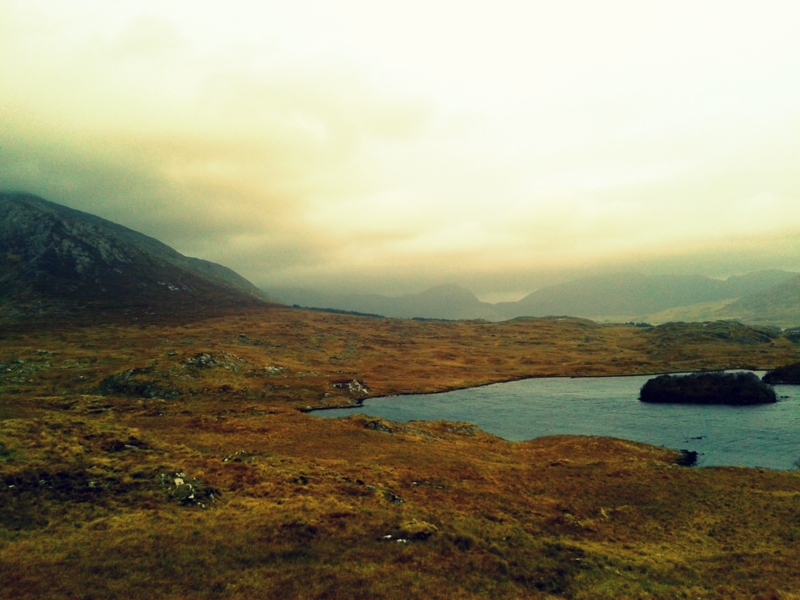
Connemara’s water is as black as a turfy pinte of Guinness. It might change depending on the day, but today, loughs are dark and the threatening sky as well. Alone in the middle of Derryclare Lough, it looks like the end of the world: wind storm, cloudy hat on the top of the Twelve Bens and the bleeding bogs.
Before the bogs, three thousand years ago, there was trees, so many trees. But then, one day, two thousands year ago or something like that, everything was torn down – successive peoples, Partholonians, Nemedians, Fir Bolg – they demolished everything, they burned down the trees, only fragile and naked grounds remained, not able to absorb the torrential Irish rain every year. This endless water turned into a waterproof mineral layer over centuries. And from the never-ending rain, from the constant moisture, bogs were born: a gigantic sponge. Covered of red heather when it’s dry, green and yellow vegetation when it’s moist, black when it turns into water, into a lough. Connemara is a burned land, rocky moors as far as the eye can see indeed, Alain Sardou* didn’t lie. Though Connemara changes throughout seasons, from green to red, thanks to the sun, thanks to the rain. I finally explore this barren land myself, last roots of Irish Mythology, where were sent rebels to Cromwell. Irish survived with their Gaelic language and identity until the famous Great Famine that broke this almost self-sufficient society. Almost everybody has heard about the Irish spoiled potatoes of the mid-19th century. If the potato blight’s devastation were unavoidable, its consequences in Ireland largely got worse because of the British government’s response: they kept importing all the others uncontamined products for their own good, starving the neighboring island. Thousands of people were dying, because of hunger itself or sicknesses spreading through hunger or poverty: the Irish Nation was a crowd of pale and hungry skeletons. This trauma still haunts Irish people now: “I’m here today because my ancestors had enough money to buy the few healthy potatoes and watch the poorer die. What on Earth did they do so I could live today?”
Yet, if everybody over the world remembers the 1845 Famine, Ireland has known tens of those before, all lethal: all what the Irish people always found is his plate was the hunger itself. For centuries and until not such a long time ago, Ireland had the best poverty, the best hunger and the best misery; Ireland always fell under this tragic fate. Every nation has more or less poverty, but a whole people of poverty, only Ireland experienced it throughout history. Her belly was either empty or full of pain, she desperately tried to enjoy the few rain drops, not nourishing but at least tasty in her hungry mouth.
Alone in the world, the perfect balance in my belly, I catch some of those myself for the pleasure of the rain melting on my tongue, while my feet sink into the bogs to my knees. I run with sheep in the wet wind, surrounded by the fog, at the smallest Twelve Bens’ feet. Free. Free like I only can be in Ireland, in the middle of those desolate and bright fields carefully given to my lonely soul.
 Fleeting Wor(l)ds