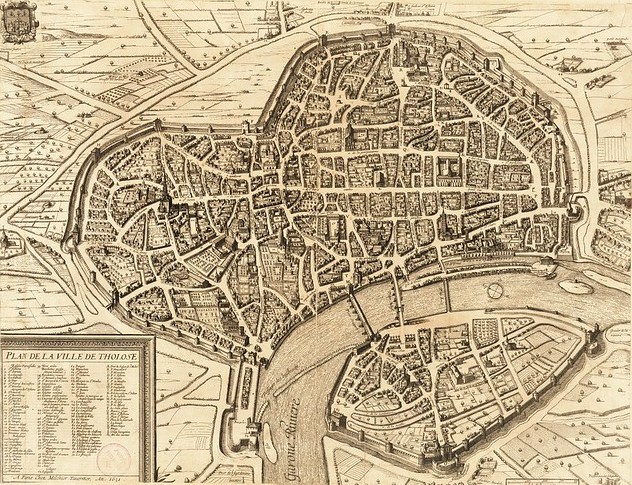
Way after Ancient Greeks, way before the Roman Empire, Western Europe – and therefore Gaul as well – was mostly Celtic. Thus, the first people in Toulouse that we’ve heard of, was Celtic too: the Volcae Testosages. Native from Bohemia, these Errant Warriors settled in Southern Gaul, in Garonne River cradle. But their wandering heart got impatient and some left with the famous excursion into the Balkans; one would even say they took part in Delphi raid and brought back what should become the famous and fabled “Gold of Toulouse”, cursed because of its stolen past… Others, much more down to Earth and less steeped in mythology, would pretend the Gold was extracted in Ariège mines. Wherever it came from, it was seized decades later when the Roman Army won over the city.
But before that, Toulouse freely flourished, even after the Roman Empire had conquered Southern Gaul: the city, nearby the Via Domitia which assured trades between Spain and Italy, kept its free will for almost ten years. Until Teutons, a German clan, challenged Romans on their favorite playground: Gaul. The Volcae Testosages, tired of their bulky Roman neighbors, made an alliance with the Germans… Unfortunately, revenge was a short win: Teutons were crushed and the newly traitor city was badly plundered by the Roman Consul. The famous Gold of Toulouse was then stolen, causing a lot of troubles to the poor Consul: apparently, the selfish scamp kept the gold for himself without sharing with his little Roman friends, what a nasty boy!
Roman Occupation, far from stopping the city’s growth, helped it: wines, tableware and other luxurious items, carried into flat boats through Garonne River, had to stop in this strategic trading place between Italy and Aquitaine. People of Tolosa then took their own share and added their farm productions to the convoy. Enjoying every benefit of pax romana, the city didn’t care much about Vercingétorix’s Gaul and really got along with Roman domination. Peace also gave time to care about what had been annihilated by wars: education, culture, religion…. Richer of its trading power, Tolosa built theaters, churches, schools and sewers within the Roman walls, running from Place du Capitole in the North to Place du Salin in the South and open on Garonne River in the West, mapped from West to East with the current Rue de Metz and from South to North with the current Rue Alsace Loraine, embracing in the Forum, current Place Esquirol. Tolosa was already a modern city, which had just drawn the survey you know nowadays even if there is no building to testify. You know, Tolosa was already an original, people were using, instead of stones, bricks of the clay lands nearby that the city still used today. And bricks are much more reusable than stones, therefore the antic city kept being rebuilt from, and on, Roman buildings…
But let’s skip ahead our timeline…
We are now in a new era, from before, we jumped after little Jesus’ birth, and the city knows its first martyr: Saint Saturnin. Tolosa had slowly converted to Christianity and Saturnin, Tolosa’s bishop, refused Roman pagan religion. As we know, Roman Empire was really serious about this kind of crimes, the poor Christian had to be tied to a bull’s leg and pulled towards the city’s gates until the rope broke… which happened at the Porterie Gates in the North, where the current Église Notre-Dame du Taur stands, named after the victim’s torture (NB: “Taur” comes from “taureau”, French for “bull”).
But let’s go further…
In Middle Age times, Tolosa was once again very popular among German People. Indeed, Wisigoths were fighting their own war in Gaul and they drew their Kingdom from Loire River to Gibraltar. They chose beautiful Tolosa as their capital, despite the defiance of city’s inhabitants towards those other Christians that refused Jesus’s deity. The royal institutions they built and the royal status of Tolosa sparkled in French sky, calming any kind of hostility between besiegers and besieged, until Francs ruined that blazing prestige. Clovis ended both Wisigoth domination and the rise of the city. Tolosa had to settle with a lower and profane status: from capital, it became a simple military base, last defence before Toledo Kingdom in Wisigoths’ hands.
Then comes Carolingian period, the city prospered, Christianity structured urbanism, the first Earls of Toulouse gained power over most of the South.
But Crusades in Holy Land jeopardized France’s balance and Toulouse as well, the Earls took part of this deadly Evangelism and died one after another, leaving the city to anarchy. Fortunately, chaos was quickly fixed by a new City Council, specific to Toulouse and led by Capitouls. This new council, partner of the Earls’ power, was in charge of trading regulation and application of the laws.
In parallel, Toulouse had become a powerful place of Catharism* being one of the five independent Cathar churches that rejected Catholicism. Of course, it created a tragic civil war atmosphere within its walls: White Catholics were harassing Black Heretics in the streets. The city was then besieged by Simon de Montfort and after his death, by the King of France himself, but the people resisted to the Albigensian Crusade to annihilate the Cathar heresy: Toulouse was a rebel soul; despite sharp religious divisions, the people was willing to protect his independence, the people was willing to defend his county and aftermath, the Earl gave his powers to the Capitouls to thank their support. Thus, the city was only bound to the Earls by the feudal oath.
A “Pays de Langue d’Oc” was created in 1271 and Toulouse was now part of France Kingdom because the current Earl (who was also brother of the King by a clever alliance) had died without an heir; yet, until French Revolution, both the City Council and the city itself were ruled by Capitouls, now elected by the people (or at least, a part of them) and established in the Capitole. Therefore, Toulouse remained quite detached from the Crown and original in its lifestyle.
The 14th century was challenging for this already challenged city: the agriculture couldn’t feed the people, Black Plague spread sorrows and dead corpses, the Hundred Years War deployed confiscations and destructions among the survivors. Toulouse Middle Age, glorious and sharp, intense and ardent, was finally and thankfully ending, but not without a tragic goodbye and the worst French Middle Age disaster: the burning of the city in 1463. Toulouse had already been through multiple fires, from wars or accidents, but this one, unquenchable torch inflamed by Autan wind, devastated every heart for two weeks. Blown by 40° gusts, people were suffocating, flames couldn’t be fought, half of the city were gone with the foolish eastern wind. Damages were so bad the people was exempt from the royal taxe for one hundred years.
With Renaissance, Toulouse was reborn, as blue as the red of its bricks, thanks to the pastel trade and the luxury textile industry growth. Capitouls started to share power with the Parliament of Toulouse, in charge of Justice, increasing Toulouse’s autonomy towards the Crown. The city, as an international trading place, knew its most prosperous times: mansions blossomed within its enlightened streets. But Toulouse rebirth was jeopardized by another blue, more exotic and popular: Indian Indigo. Happiness was ephemeral, the city declined, forgotten by its traders.
And the Wars of Religion, opposing Catholics and Protestants, made the troubles even worth. After bloody riots that had caused thousands of deaths, destroyed numerous of buildings and provoked the expulsion of Protestants in 1562, Toulouse stood as a catholic haven surrounded by a protestant county. Paris St. Bartholomew’s Day massacre found its mirror within Toulouse prison walls where all the protestant prisoners were slaughtered a few weeks later. Henri de Navarre, future Henri IV, and the Queen Margot’s wedding calmed war fires without easing aggressive hearts, however Toulouse made a struggling peace.
The city lately changed, it slowly molted, the Canal du Midi was dug, quays and promenades were arranged. New plagues were murdering streets, famines were eating new souls, the 17th century was devastated and one tried to save indigents building the Hotel Dieu.
The city lately changed, it slowly molted, major urbanism works inspired by Paris were organized and one turned around the Grand-Rond. Toulouse hadn’t forgotten its religious fever, the 18th century persisted and ultra-Catholics unfairly condemned a tragically famous Protestant, Jean Calas, officially because he was accused to have killed his own son, deeply because he talked to his god in a different way: he was put on a wheel at Place Saint-Georges, choked and burnt to death two hours later. His awful tortures inspired Voltaire his “Traité pour la tolérance” that Humanity doesn’t seem to have understood yet…
And then, the Contemporary World that we know built its first foundations…
French Revolution deeply changed the city’s running and role, its social and political structure. Even if in the rising beginnings, Toulouse was more of a watcher than a real rebel actor, when Capitouls and Parliament’s privileges were in jeopardy, when they complained in the streets, they didn’t get any support from the people. Toulouse, imprinted of new freedoms, didn’t care much for these old protectors from the past anymore. Yet, the Old Regime institutions disappeared and Toulouse lost some local influence piece after piece. Nonetheless, Toulouse stood with its choices, Toulouse fought against the royalist rebels during the Battle of Toulouse in 1799.
Forged by those risings, Toulouse was ready for the new century. There was not a lot of factories in town, except for the Tobacco factory, therefore the city didn’t really take part in the Industrial Revolution. It modernized little by little, knew its own Haussmann renovation and opened to new worlds… The city became the bridge between Mediterranean Sea and Atlantic Ocean when the Canal Latéral à la Garonne got ready and embraced the Canal du Midi over Ponts-Jumeaux, the city got closer to the national capital when the Gare Matabiau opened and unrolled its iron tong towards Paris.
But elements unleashed once again within the pink lady’s walls: Garonne River ranted and raved over the flooded banks, streets sank, hearts drowned. Toulouse ended the 19th century feet in water and soul in socks, hoping to never knew this kind of water rage ever again thanks to the brand new bridges.
Toulouse 20th century was a flight deck, was a land of welcome…
Aviation pioneers were establishing the Airmail and gathered in between flights at Le Grand Balcon Hotel to write their novel of adventures, to talk about the gazing stars and dream about the lonely sea. Latécoère was building flying steamers, Saint-Exupéry was conversing with the Little Prince and Mermoz was thinking of a better and socialist world.
French countrysides were emigrating, the Western farmers came to the city, the Northern French dodged the war. Foreign countries were exiling, Italians ran away from Mussolini, Spanish fled Franco. The city changed, the city diversified.
Then, comes the hungry war. Vicious, invisible and almighty. The First left it in peace, the Second was a Dead-maker. Toulouse was a collabo’. Toulouse was Vichy. Toulouse waited and saw. Toulouse was De Gaulle. Toulouse was communist. Toulouse was German. Toulouse was socialist. Toulouse was resistant. Toulouse was finally free. Traumatized and brave, like the rest of the country.
Aftermath, the post-war boom was blazing, Toulouse as well. The city earned its stripes of economic powerhouse, being popular among students and chosen by the aeronautic industry to match the land’s flying history.
What about nowadays?
Toulouse had kept its originality and authenticity; it had kept it simple, it had kept it human. Hungry of knowledge and culture, Toulouse welcomes students that claim their love in every language, Toulouse inspires artists that dream in colors, songs or rimes. And that rich and cheerful atmosphere brings new people every day, full of their own legacy to flourish the local one. Toulouse easy and friendly way of life is even praised each year in local – and international! – medias.
In a France more and more focused on Paris like it was the center of the world, Toulouse cherishes its peculiar charm and knows there is nothing to be jealous of; the city is far from the noisy and pride French capital and wants to keep it that way.
In conclusion, Toulouse keeps its independent and rebel smile that makes the poets sing… And me as well !
* Catharism, from greek “the pure [ones]”, was a Christian movement whose followers were recognized as heretics and persecuted in France.
 Fleeting Wor(l)ds
One thought on “Once upon a time in Toulouse”