Once upon a time the world was born. Once upon a time was Pangaea. Once upon a time were a huge earthquake, a massive eruption and a series of shifts; once upon a time our world tore apart. Once upon a time was continents’ drift. Once upon a time was Iceland, mother of the last united piece of our tectonic plates, Iceland shelters America in North-West, Iceland welcomes Eurasia in her East side, Iceland is one little piece left behind in her heart.
Iceland was the last piece of Earth inhabited by humans. Until Vikings’ arrival at the end of the 9th century, there was nothing. Icelandics, like Irish, have their own Book of Invasions, Landnamabok, and they invented their Nation’s tale, Islendingabok (Icelandic’s Book), to tell their world’s origins; the Wise Ari wrote their legends with his own truth and imagination. According to him, when Norse warriors landed on this volcanic isle, papar, Irish monks, were already praising their new Christian God there. Ari was right, but he messed up with his timeline because there were only volcanoes, hot springs, low lying beech woods and extensive grasslands when Vikings, officially led by Ingólfr Arnarson, arrived with their cattle to this desolated land. Irish monks did reach this Northern part of the World, but it was later, way later… when they might have tried, after their monasteries were looted, to find a safe haven in this even more inhospitable land than theirs?
First people didn’t know monarchy, they were led by local and pagan chiefs, Godar, organized by what they called the Commonwealth. Norse and Celtic cultures were intertwined, people spoke settlers’ language, Norraena, but Vikings had already stopped in Ireland and reproduced some Irish customs. However, they only praised Viking gods: Odin, Thor, Freyr, Frigg, Freya, etc… According to this old religion, warriors who died on the battlefield joined Odin in his great hall, Valhalla; and those who quietly died in their bed had to settle for eternity with Hel, the Goddess of Death. To lead this journey towards eternity, some were poetically buried with a ship or a horse. As for women, they must have wandered in the limbos forever since nobody ever mentioned their afterlife paradise.
And they invented other stories about Elves and Trolls hidden in volcanoes, sometimes frozen forever in sleeping rocks because, at the end of the endless winter night, they got caught in the middle of their big reunion by summer sun.
Then, Christianity, maybe because of some Irish praises, slowly took over Icelandic souls. The two religions lived side by side for a while, until the country peacefully completed its conversion in 1000, by government’s decision. Paganism was still authorized in private though. The Island went through a big change: communities soon hosted new buildings whose crosses raised towards the sky, thus telling the local Godar‘s power. Church’s bell called people for worship; inside, pictures from another world covered walls, masses were celebrated in an alien language and some weird songs were sang, people discovered how Christ’s blood and flesh tasted to atone what had become sins.
The Free Icelandic State grew by working the land and raising cattle. The Land of Ice was also many expeditions’ basis to explore the world: Icelandic Vikings were indeed the first to discover America five hundred years before Christopher Columbus. The country knew its first wars, the 13th century was full of struggles that deeply changed historical Icelandic landscape. Local chiefs, whose power grew over villages towards regions, were eager for more wealth and fought for Iceland lands with axes, spires and stones. First sagas were written to tell Sturlungs Age, today known as old literature classics and making, back then, Icelandic people the most faithful Norse legends’ apostles.
Norway put this bloody shed to an end, thus ending Iceland’s independence as well. Norwegian King wanted more lands, Icelandic people wanted peace and the Old Covenant (1262-64) made Iceland part of Norway’s kingdom. A new legal code and a new system of government was introduced, fisheries became the first livehood, even though farming was still Icelandic’s favorite activity.
At the end of the 14th century, the two royal families of Denmark and Norway united and Norwegian Crown was absorbed by Danish Crown; therefore, Danish King also ruled over Iceland. Yet, the 15th century felt more English than Danish because English (and German) fishermen sometimes overruled Danish power, knowing what the true value of the country was: fish.
The 15th century was also doomed by Black Death, the plague wiped out the country entering and exiting this centenary, desperate charms praising for God’s help never prevented people from dying though.
When the Danish King converted to Lutheranism in the 16th century, he forced all his territories to convert with him. The deadly reform shed Icelandic blood and destroyed catholic monasteries, massacre only ended when Catholicism was officially forbidden and when the last catholic bishop was beheaded November, 7th 1550 in Skalholt. This slaughter ended Icelandic Middle-Age and increased Danish Crown power, since Catholic wealth was handed to the greedy King. Iceland knew some progress’ benefits, although the population, deprived of freedom, couldn’t enjoy any. They had to be afraid of God and a painful afterlife, then nobody dared to challenge their unfair condition.
Danish hegemony grew worse: in 1600, the Crown instated a trading monopole, especially on fisheries, preventing the development of an Icelandic merchant class. Fishes were underpriced and agricultural goods overpriced (then impossible to export), maintaining people’s extreme poverty. In 1662, to prove this obvious domination, people had to acknowledge the King’s absolute power. Fortunately, most official powers were Icelanders’ and Icelanders blindly believed they were ruled by Icelanders.
The 18th century was, in Europe, the industrial revolution dawn, with all the progress premises it could bring. Iceland told another story though. Danish Crown invested in Iceland woolens industry, Reykjavik started to develop and the country slowly modernize; yet it was not enough to balance the human tragedy the nation would go through. Epidemics and famines infected this Deadly Century, most of the people died, especially because of the Haze Famine (1783-85) which would also change Europe political landscape forever. In 1783, Laki volcano exploded and provoked the most dreadful disaster Iceland has known, Móðuharðindin. A part of the island sank under lava, volcanic ashes infected the land, cattle died intoxicated, people were killed or exiled. And volcanic fogs don’t care about borders, the sulphilde cloud also suffocated European continent for weeks, so thick the sun was bleeding, so thick countries knew a semi night for a while. In Europe, people were killed as well. And winters after that were so harsh all over the world, jeopardizing both crops and souls, giving away monarchies to revolutions. Laki volcano changed the course of history. The forgotten island so close to the pole freed the world from kings’ rules.
The Icelandic 19th century slowly and peaceful marched toward Independence. The idea of a Nation grew in Icelandic mind, people overruled by foreign forces for centuries started to regard themselves as a separate nation than Denmark, Icelandic agitated self-determination flag, as blue and white as their landscapes. Icelandic began to know better their identity, they valued their language, this frozen isle was immortalized with poetry and paint, and artists like Ásgríms Jónsson led people to realize surrounding rocks were not only obstacles to their life, but mostly witness of their origins and breathtaking gorgeous.
In 1848, a revolutionary wave sang freedom throughout whole Europe and Northern wind was not strong enough to save Iceland from it. Danish King had to deny his absolute power and Jón Sigurðsson, Independence movement’s leader, questioned the Old Covenant to stand for his country’s freedom: people swore an oath to the absolute King; yet the absolute monarchy was abolished, Iceland had never agreed to be ruled by the state of Denmark, only the King, and the relationship needed to be redefined. Of course, colonizing rulers had some poor excuses to not accept this new world: Iceland had been an economic burden for centuries and the indebted country would only get its freedom once cleared. Jon was not an easy man to break and he smartly pointed out huge profits made by the trading Danish monopole throughout years, Iceland was the lender and not the payer.
Therefore, in 1851, Icelandic asked for self-determination through their advisory assembly created in 1845, the Alpingi, but were denied by Danish authorities. That National Convention was nonetheless crucial in the independence process, since the Alpingi got legislative power in 1874, leading to a Home Rule in 1904.
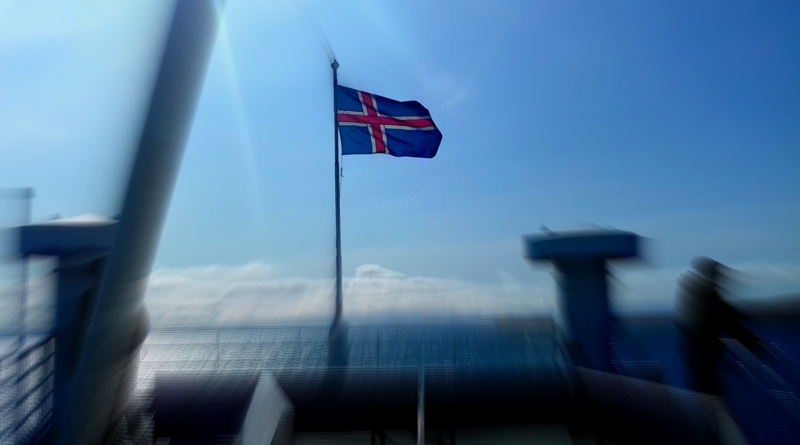
The last battle was about a flag. Iceland still had to display the Danish flag, but people preferred their cross as white as their glaciers on a blue background like the sky, ocean and mountains. When this illegal and proud flat was flown and soon forbidden in 1913, people rumbled and Danish government yielded: in 1915, Iceland could finally show its white cross surrounded by a thin red line as a reminder of volcanoes, on a blue sky.
But Iceland only knew an absolute and true independence the 17th of June 1944, as the Second World War fought its last year of battles.
 Fleeting Wor(l)ds
One thought on “Once upon a time in Iceland”