An Inuit legend tells the Earth and Mankind’s birth: the Human race was eating the ground and living in an eternal night. Nobody died then, they became old, very old, and blind, they couldn’t move at some point, to a frozen state maybe; but nobody died. However, one day, there were too many humans, frozen or stepping our planet, and by dawn, a huge wave swept the world. Two woman tried to bargain with the Earth’s fate: “Let’s be spared even though it means to live in the dark. – No, we have to accept Death in order to live in the light”. The last one was heard and day rose. Then, mankind didn’t need to eat the ground anymore, they could live in open sky. With Death, Sun, Moon and Stars appeared. It was those who had died’s souls forever shining in the firmament. This mythology doesn’t talk about Alaska, it tells one history of the world; yet, only people living in the Northern Hemisphere, in an immortal night, would dream of such origins so similar to their extreme changes from dark seasons to bright ones. Therefore, in my opinion, Inuits tells me Alaska’s metaphysical birth.
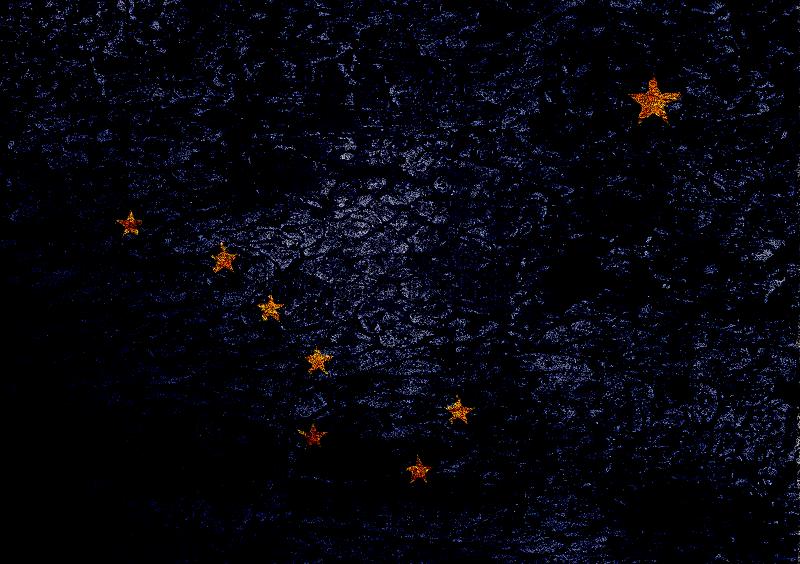
In reality, Aleut people were the first to name this eternal night land: Alaxsxaq. The object toward which the action of the sea is directed. A few millenniums later, Benny Benson, born from a Swedish fisherman and an Aleut woman in Seward, gives a flag as cold as the place: the Big Dipper and Polaris.
This frozen land knows then its two symbolic births, but what about the Nation? What about those mountains, land and rocks fallen from the sky way before mankind arises from the water’s depth and make this hostile territory their home? What about those spread people which look alike but can’t see it?
First Nations
In the US, once they realized Indians was not an appropriate name for people from America, they decided to call them Native Americans, or in this specific case Native Alaskans. As for me, I prefer the more accurate Canadian designation : “First Nations”.
14 000 years ago at least, the first Eurasian people reach Alaska throughout Bering Straight and start to settle this piece of land and the rest of the continent. Archaeological and genetic researches, as oral traditions, tell us other migrating waves happen for the following millenniums (12 000, 4200 and 1000 years ago).
Before Westerners’ arrival, Alaskan life is built around complex community laws based on art, wildlife and spirituality, all three intertwined. Each tribe’s culture is characterized by their food – some are hunters, others are fishermen -, their home, their dances, their songs and their traditional clothes. Resisting to extreme weather, they work the ground with respect and harmony.
Before Westerners’ arrival, there is not a whole but a multitude of clans living in peace most of the time.
We did not have a concept of boundaries, of unseen lines traced over the Earth and dividing the land… If someone established a fish camp, it was considered that person’s or that family’s fish camp. It was permanent in everyone’s mind and considered settled.
Tommy Ongtooguk

To learn more about each tribe
Russians’ Arrival
In 1741, the journey of Vitus Jonassen Bering, Danish explorer in Russian service who gave his name to the Straight, the sea, the island and the glacier, makes the world know about the sea otters profusion in South Alaska. Thus, hungry Russia conquers and invades that American sidelines land despite Indigenous resistance. Russians become big sea otters’ furs traders. Unangax and Sugpiac on the Southern Islands (purple on the map) are the First Nations geographically impacted, Native people are forced to work for the Russian companies. Sugpiacs are particularly affected, they lose 10% of their population in a century, and a whole part of their culture disappears: their songs, their rituals, their identity, the wises’ voices. But in the end, the rest of the country is not spared by colonisation either.
Indeed, Russian invasion also brings other settlers: British set outposts on the Yukon River, mostly Athabascans inhabited (Hudson Bay company will even cross the Canadian border to increase its activity), American traders (Men of Boston) compete with Russians over wales hunting in Arctic Sea, depriving Inupiaq and Saint Laurence Island Yupik in North-West Alaska (orange on the map) from their first sustainable food. This economic boom leads to a profound social change and a massive environmental destruction the First Nations are not prepared for.
Traditional cultures are even more jeopardized when the first Russian Orthodoxe mission settles in 1794. Attracted by the respect of indigenous languages, a lot of Natives convert in order to blend into this New World stealing their lands. This evangelization is still today the ultimate remain of Russian occupation. White men also bring with them a bunch of devastating diseases that eradicate lower immunity First Nations. It then questions even more deeply and viciously traditional cultures: shamans and healers are unable to beat those epidemics and they loose populations’ trust. Therefore, this foreign overtaking on the country’s economy and ressources leads to a terrible identity crisis throughout First Nations; their sovereignty is totally lost. Except for Tinglits in South-Est Alaska (green on the map) who bravely and triumphantly resist, they will indeed never be colonized by Russia.
American’s purchase
Military and economically weakened, and in order to stop British expansion, Russia decides to sell Alaska to the US October 18th 1867, now celebrated as Alaska Day. The region changes from the Julian calendar to the Gregorian calendar and from Friday, October 6th to Friday, October 18th.
At Alaskas purchase time, most of the lands are unexplored and used as military or commercial territory. Of course, Americans are as keen on furs as Russians. And when the first gold nugget is found on the Canadian Yukon River’s shores, Alaska experiment its own gold rush, attracting a lot of gold diggers. And when gold (and then copper) is actually found in Nome in 1899, this uncertain place very (too?) quickly turns upside down towards progress: railroads and other traveling ways are built drawing the legendary Iditarod trail which carries food, materiel and mails, which carries gold that so many men risk their life for.
In parallel, fishing as a mean of support is constantly jeopardized by alien occupation. Wales are hunted without caring about extinction nor population’s food. Many salmon canneries open in the South, damaging communities’ fishing ressources in an other way.
Americans’ settlement also badly affects different traditions’ culture, especially because Indigenous languages and religions are forbidden and people have to convert to Christianity. Tribes lose their citizenship, they are excluded from schools, shops: they can’t find jobs or housing. However, in 1922, the Alaska Native Brotherhood fights and wins over for the Native Alaskan vote (two years before the Lower 48 Native).
At that time it was very easy to understand the objective of school, because it was to “civilize” you. To civilize meant you had to speak English, you had to give up your Native ways and wear Western clothing and live in Western housing and be Christian.
Martha Demientieff
Once the gold rush simmers down, the rest of the US doesn’t really care about that poor in ressources, cold and remote land; nobody really understands its reality. Alaska’s status changes several times; nobody would want to make it a state for the entire world. Although some get profits out of Alaska’s isolation: the province already struggles to feed its people, since its most valuable ressources are traded instead of feeding the population – both whites and natives – and needs to get all its products and goods traveled throughout Southern territories, then shipped from Seattle that prospers at Alaskans’ expense. Later on, like any other American territory, the Great Depression destroys this polar land and the federal government tries to stop the nasty bleeding by an organized emigration from Northern States like Michigan, Wisconsin and Minnesota, under the belief that only those who grew up in similar climates could handle life in Alaska.
Here comes the Second World War… Alaska, like Hawaï, is the American giant with feet of clay’s Achille’s heel. After Pearl Harbor, Kiska and Attu Islands are the only American territories physically impacted by war because invaded by Japan. Other Aleut close islands are then evacuated for strategic and safety reasons. People are interned in inadequate conditions because the government can’t – or don’t want to – provide the minimum comfort; many suffer or die. After those tragic events, the Alaska Native Brotherhood and Sisterhood raise their voice and an anti-discrimination law is voted in 1945. It won’t be enough to prevent those Aleut population from being relocated though, their ancestors’ lands are indeed considered too difficult to defend. Stereotypes are tough to beat as well; despite this law, Eskimo ice creams are still sold based on the same cliché than Banania chocolate or Aunt Jemina syrup.
However, Second World War has its own benefits since it changes what average Americans think about this strange land: they start to understand its strategic value, they even consider the idea of making it the 49th State of America(1). The weak and depending state is over. July, 4th 1958, the Alaska Statehood Act is voted, allowing Alaska to join the Union on January, 3rd 1959. Oil discover a decade later proves them right.
Alaska
We know the place we belong by where our family is buried, by where we were born.
Martha Demientieff
Thus, controversy Alaska, more divided than united Alaska, becomes one and only, becomes utterly American. This land north of the future(2) tries to define herself, to know who she is, with all her differences and resemblances.
Alaska touches the Arctic where the ocean becomes a walkable surface, the snow is a building and the life exists in the most improbable crannies. This extremity acts both as a foreground and a context to understand how people live and interact. Alaska is a polar desert drawn by a few roads, some villages are only accessible by boast in the summer and snowmobile in the winter. This is the reason why the Iditarod trail was such a revolution back in the days and became a legend when my faithful childhood memory Balto saved the whole town of Nome from a diphtheria epidemic in 1925. If sled dogs hadn’t won the serum race in five days, the entire town would have died. Today, modern world brought planes as a bridge to those remote villages. Thus, the sound of radial engine overhead becomes a sound of comfort in Alaskan sky, a hum that indicates home.
Alaska is like a huge village, a giant space in which everybody knows and takes care of everybody. Even spread. Even hundreds of miles apart. A giant quiet heart that brings a unique path. Alaska is like a huge village that never stops growing since this wild land keeps attracting numerous Lower 48 Americans, willing to escape the overcrowded and stressed continental zone.
But most of all, Alaska is a divided Nation whose wounded and opposite inheritance struggle to reconcile.
When oil was discovered in the late 1960’s, the ownership of lands jeopardized by Western’s arrivals is raised (most of oil companies are therefore owned by Native communities and lands were redistributed a while ago). It then also questions First Nations’ citizenship and their role in Alaskan society, starting a slow healing of lost traditions and a soft assimilation of all cultures.
Yet, issues are still vivid. First, because different tribes struggle to combine their amputated traditions with the modern world. Then, because society keeps creating two different and opposed identities: Cheechakos (literally New Comers, in other words White Men) and Natives. The striking example would be hunting permits – because every full time(3) Alaskan is a hunter(4): in order to preserve the environment and since it is the only sustainable food in Northern Alaska, only Native people are authorized to kill polar bears and whales, creating the eternal differentiation between millennium Natives and centennial Natives. What if, instead of putting limits in term of origin(5), they put it in therm of residential place? Then, those who can only live out of whales and polar bears would be allowed to hunt them, we would still preserve the environment and nobody would be fighting over who can be called a Native or not.
Because in the end, Cheechakos are not always white and Natives are not always Alaskan. Like with English colonization in Ireland and settlers becoming more Irish than Irish people, new comers have now adopted the Alaskan way of life, the only possible way of life on such a demanding land. They hunt, they follow the adamant seasons cycle, they coexist with dangerous wildlife. No technology can fight the reality of water turning to ice at certain temperatures, jeopardizing the most simple invention: bathrooms… Those two nations therefore have way more in common than they think, they don’t have any other choices. Such a place don’t leave any other options.
History, injustice, horrors, spoliations won’t ever be erased, they are our modern societies’ fondations. We won’t ever be able to go back in time, before Christopher Columbus rediscovered America, before alcoholism and western diseases jeopardized Indigenous’ future. However, we can heal those wounds and build a new world with new rules. Thus, once State took its responsibilities and acknowledged history’s mistakes, once victims and their descendants bravely start their long and complex healing, we have to stop living in oppressed vs oppressor’s, victim vs defendant’s, avenger vs repentant’s pattern. We have to accept changes are slow and be patient in order to make forgiveness more than a word, in order to make forgiveness a reality. Then nobody has to apologize anymore for his – real or assumed – ancestors’ mistakes. But mostly, people have to make a choice: fight the ownership of the land, like Irish did a century ago, like African and Asian countries freed themselves later; or renounce to a war that nobody wants and that would shed more blood than freedom; in order to create a common Nation. Because there is one thing Cheechakos and Native have in common: their love for Alaska… A lot of Native traditions intertwine with a land where people were born, where ancestors rest after death. New comers might not have grandparents buried with salmons, but they not only choose to settle in Alaska, they choose to stay, because of that same unbreakable love for this new land.
And it should be the only and beautiful truth everybody remembers.
What you do not see,
Esghallghilnguq, Nagaqullghilnguq, Nanghiilghilnguq, Nalluksaghqaq
do not hear,
do not experience,
you will never really know
(1) Alaska is the 49th state to enter the Union but Hawaï soon follows six months later.
(2) North of the Future : slogan created in the 1960’s to value Alaska’s wealth.
(3) A lot of Americans from the Lower 48 progressively move to Alaska, they first only spend summers over there then, absolutely crazy in love with this rough and beautiful place, they will settle forever with no fear of winters.
(4) Beyond the diversified wildlife, hunting is mostly an economic and logistic necessity: there is no such a thing as supermarkets for villages off the grid and products are mostly imported from Canda (and terefore more expensive) for the rest of the state.
(5) Since 1934, American laws define who is Native or not, often against each tribe’s own rules, and leave no room for cultural exchange and diversity.
 Fleeting Wor(l)ds