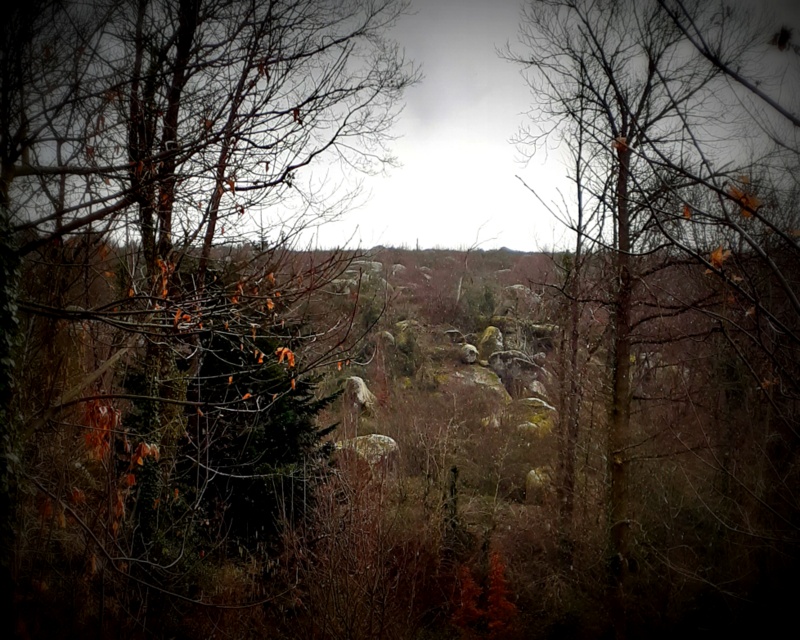
Where is Sidobre?
For me, I must confess, I had never heard of it before this little escape !
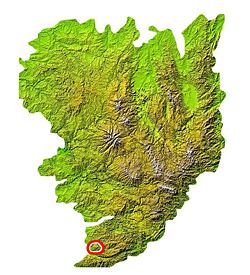
You might laugh – I did, denying this unbreakable truth -, but this granite land located in Tarn county actually belongs to Southern Central Massive (the red circle on the map)! I am not lying: CENTRAL MASSIVE, that ancient chain of volcanoes any French would spot around Clermond Ferrand; well, Sidobre marks its gate.
What is Sidobre?
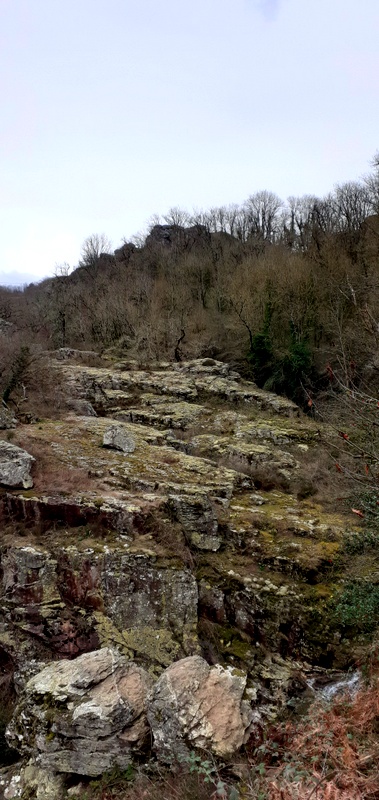
Sidobre was born 285 million years ago from a molten magma produced from rocks in fusion down to 20 km depth, under a massive mountain which only remains are Central Massive, Black Mountain and Sidobre. Erosion and magma cooling transformed into a crystalline rock: granite. Thus, Sidobre – which, according to scientist, looks like an almond lentil – is a granite block measuring 10 km long, 10 km wide and 10 km deep.
Sidobre is now France biggest set of granite rocks and the first French granite’s producer. Apparently, Champs Elysées’ and Arc de Triomphe’s pavement even come from there (and not Toulouse’s Alsace Lorraine Street’s like my dad thought; those come, way less local, from Angola !).
A little piece of Sidobre’s history
Like any part of the Earth, this one was once refuge of loads of mythologies ; among those, the most famous was the Legend of Alazaïs, Lady of Burlat.
Adélaïde, the purple eyed princess, is the daughter of Raymond V, Toulouse’s Earl, and Constance of France. Her mother would have found shelter in Burlat (in Sidobre of course, or I wouldn’t write!) after she was exiled by Raymond V. Thus, Adélaïde was partly raised there and would have been courted in the current Priory of Burlat. Arnaud de Mareuil, a famous French minstrel, was madly in love with her and was one of the rare troubadour who only loved and sang about one lady; he partly created the legend around his lover whom he praised beauty and moral qualities. The artist, though, was not the best known of her suitors since Alphonse II of Aragon was also devoted to the young lady. But, in the end, Adélaïde (or more probably reasons of State) chose Roger II Trencavel, with whom she had quite cold relationships. One might guess her troubles them: a spouse’s disillusion when her husband was absent and indifferent; worries about growing tension towards Cathare believers who she respected, doomed by an upcoming crusade; and, despite poetry and religious consolations, melancholy of her impossible love for Aragon’s King.
Thus, we can run into Adélaïde’s Pavillon, stage of her mythical loves, in the current Priory of Burlat; although, it is unlikely the priory was built by Toulouse’s Earls since the village was part of Trencavel’s territory! Yet, a few documents prove Adélaïde’s attachment to the place she came to escape Carcassonne’s court after her wedding.
Vous me tourmentez tant madame, vous et amour,
Arnaud de Mareuil
Que je n’ose vous aimer ni ne puis y renoncer,
L’un me poursuit, l’autre me fait arrêter ;
L’un m’enhardit, l’autre me fait craindre…
Et le visage doux que vous savez tellement me faire,
Me font tellement vous désirer et convoiter
Et j’agis en fou car je ne sais me séparer de vous…
You both torment me so much, madam, you and love,
Arnaud de Mareuil
I may not dare to love nor renounce,
One sues me, the other stops me;
One makes me bold, the other makes me scared…
And the sweet face that you know to present to me,
Increases my desire
And I’m acting crazy because I can’t part from you…
Then came times, after a millennial leap in centuries, not of legends but French Occupation’s and War’s Dark Hours. Like any rough and remote landscape, Sidobre gave a perfect shelter to Maquis Group of Resistance, among which the Corp Franc of Sidobre.
During winter of 1943-44, local secret resistance groups (the ready Maquis) were formed. These Maquis, supervised by leaders from the dissolved Armistice Army, were local groups of the young men who had refused the STO and other clandestine volunteers, willing to pursue the armed struggle against the occupiers. Financed by local industrial, men were supplied by retailers and farmers of the region. Yet, they were only equipped with very limited arms and given a very elementary military training.
The disembarkation at Normandy 6 Jun 1944 accelerated the establishment of a true military organization of the Resistance in France in general and locally in Tarn county. At the end of July, the Corp Franc of Sidobre, counting 250 me, was relocated in local farms and airdrops finally gave enough weapons to be properly trained and fight for the Liberation in August.
A little piece of my Sidobre’s experience
I need, first, to contextualise my journey: I traveled through Sidobre by little touches, lead by my paternal family for a surprised excursion in the end of February. Landscapes had therefore perfectly surrendered to winter, no Spring’s promise. Sky was grey, wind was blowing like a cascade, rain even payed us a visit on the way back and roads almost tasted like the French “Empty diagonal”. We could still find some beauty in tired landscapes under the clouds though. A few sites has learned how to keep their majesty, millennial and wise, through each season. Fresh air was exhilarating, pure and full, fated to upcoming sunny days. Company of my loved ones was rejoicing, faithful and light, doomed to be out of time.
We then left by a windy Sunday and a shy sun, towards an unknown destination despite a bunch of names sown on our way.
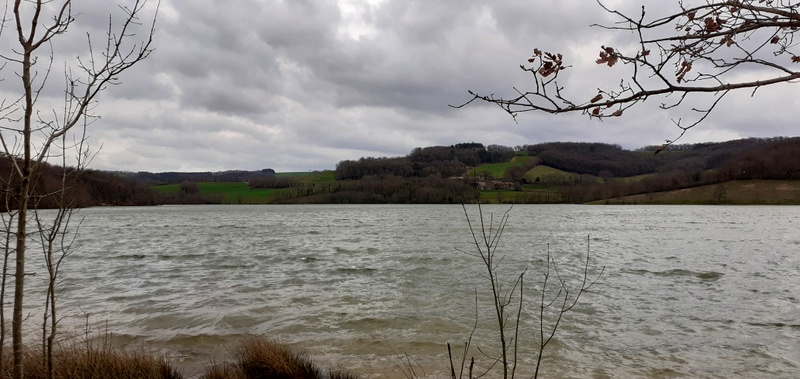
We first stopped, a bit less ignorant as miles went by, at Bancalié Lake for a picnic and a walk. Fringed by a 10km path, the lake offers a sweet promenade through forests and hills (more informations here). You may, half way from the dam, have a little detour to the castle; for us, we got a glimpse from down and far, it was enough… Wind was rough, trees were naked, water was nonetheless electric and mesmerizing blue under a grey sun.
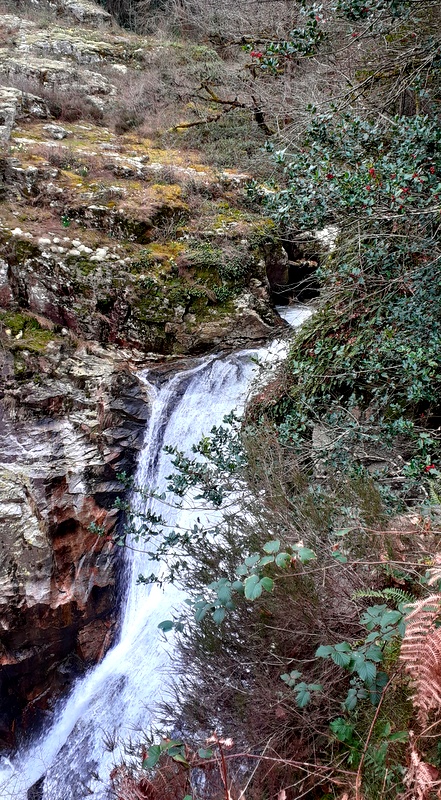
Our legs stretched, a few more minutes to kill before curfew, we drove by Arifat Cascades. Road’s meanders were already a beautiful surprise through medieval tour and young canyons… Despite Broceliandre’s mystery of the place, we only got a promising sample of the actual waterfall… We hadn’t research enough – if only we had checked the map, we would have known about the bridge on our way and we wouldn’t have turned back way to early, defeated by wind. We sadly stayed on the wrong side, so close to running waters. [In order to se what we missed, here are all the informations you need.] Hopefully, I was starting to get a better and more precise idea about rough and enchanting Sidobre’s relief.
After this failed exploration and a few GPS’ tricks, we finally reached our roof for the night: Philou’s Mongolian Yurt which, despite a few random designs and some airflow, offers a nice viewpoint on the scenery and one original night in refreshing and exotic environment.
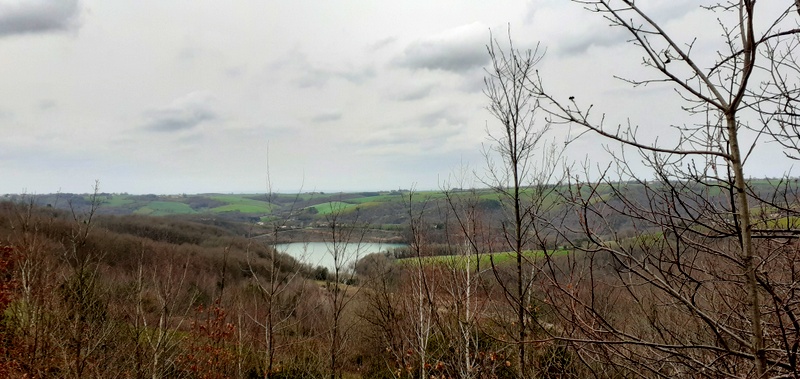
The next day, after a chill but cheerful outdoor breakfast, we were ready for new adventures. In between 10.30 am and noon, our mind took a blow though. Roads were desert and so were fields – except for open sky dumps -, and villages were abandoned. We really didn’t feel like living there, even less visiting back one day. After those desolated lands, we chose to ride the scenic road above Agout‘s or Gijous, I am not sure anymore but it ends with « ou », which offers so little glance at the gorge in the end. It seems feet are a better way to explore its roughness than wheels.
We were therefore a bit disappointed, hungry and teenagers wanted to go home; it was time to fill our belly up in order to ease our mind near Sidobre Rocks. Well-fed, we were ready for a “short” digestive walk, starting at the picnic area of Beyriès (yellow signs) and following Sidobre “high places”: Goose Rock, Three Cheese, etc… As for us, we went for a 40 mins part-walk turning back at a-lovely-village-whose-name-I-don’t-remember and, if we didn’t meet “rock-stars” by foot, we still waved hello to the must-see Peyro Clabado before driving home; and, if we didn’t meet “rock-stars”, the rocambolesque path and our reflection in the Lake of the Merle‘ blue and wet waters, hooked me on for a come back by a sunny day.

 Fleeting Wor(l)ds