
Indeed, some were born from Jove’s thigh*, and some drew Charlemagne’s arses in stone! Odds are not always in your favor in life… As for me, being born by an autumn wind and drawing my way step by step, day by day, is a fate bringing me enough joy without me needing Jove’s thigh nor Charlemagne’s arse, and I enjoy every detour and storm of it. But it’s not what brought me here today, I might write more about my happiness on Earth later among my opinion columns, a bit lonely for now.
Let’s go back to our big men and their soft tissues!
By a May day, one of those days when the air suddenly swings from cool spring to hot summer without a warning – tonight, after a heat waved week during which June has broken its heat records for the season, that Thursday of May would probably feel lovely but then, a hot haze wrapped both landscapes and my heart and took me by surprise ; by a May day then -, I decided, with one of my favorite walking pal, to ride Charlemagne’s arse and meet Notre Dame de Carla blindingly watching medieval Lagrasse.
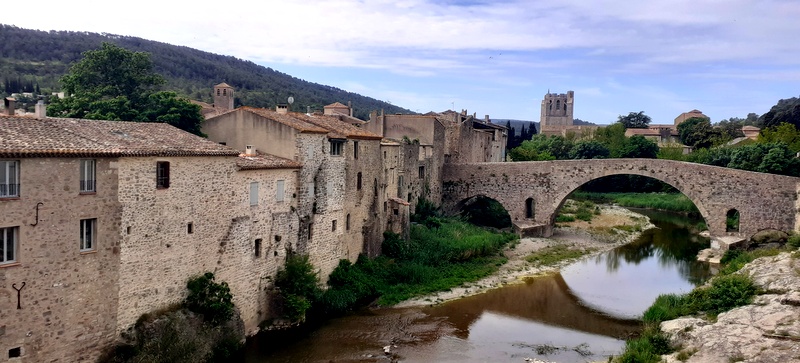
We thus straddled our brave carriage and pierced magnificent hills and glens from Carcassonne to Lagrasse, those we call Corbières. While winding along multiple streams, the goal didn’t matter much, the way already mesmerized me. The element of surprise was probably taking its toll as I was gazing at this fantastic scenery which could have been set in any other country than on this very French road; or at least, that’s what we believed with my co-pilot.
Once arrived to Lagrasse, whose historical bridge was inviting us, a bit early, to walk its timeless streets, we chose to leave the village behind, like a reward after our easy hike. We started the path “a bit longer than Charlemagne’s buttock” as the description claims, which had given me a laugh the night before and whose funny name was enough to convince us. For the record, legends say our very own Charlemagne was riding his imperial butt on the hill, when his horse tripped, throwing good old Charles ass over head with his fleshy back for only comfort between the ground and his fall. What the heck was Charlemagne doing in the area, I don’t have an idea! Indeed, the imperator widely surveyed both Europe and France, marking a lot of places among which Lagrasse apparently… Maybe was he having a little escapade after his siege at Carcassonne (which I will tell more about in a special article about the UNESCO World Heritage Site) ?
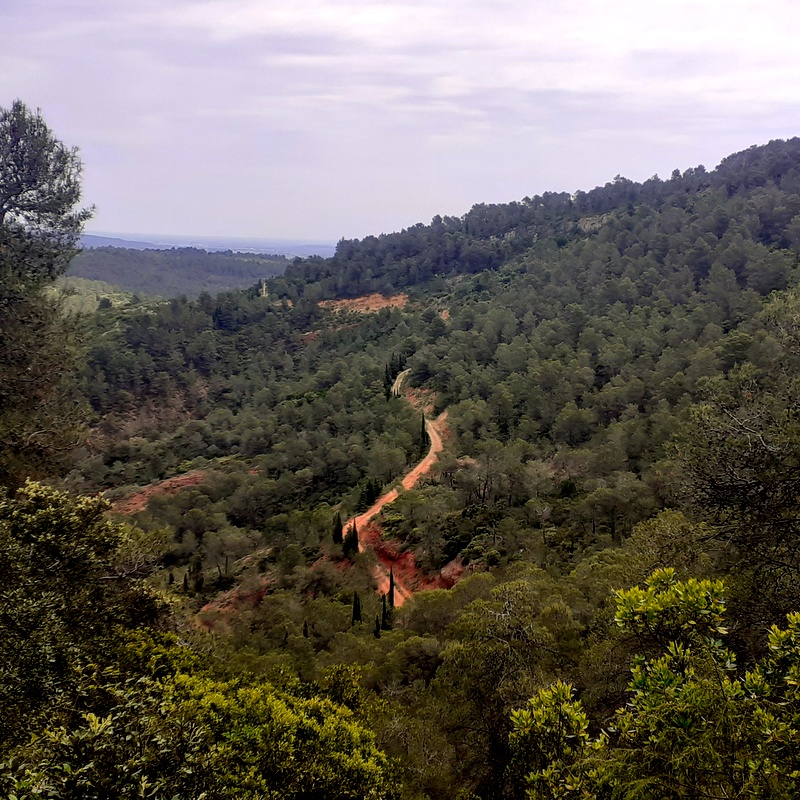
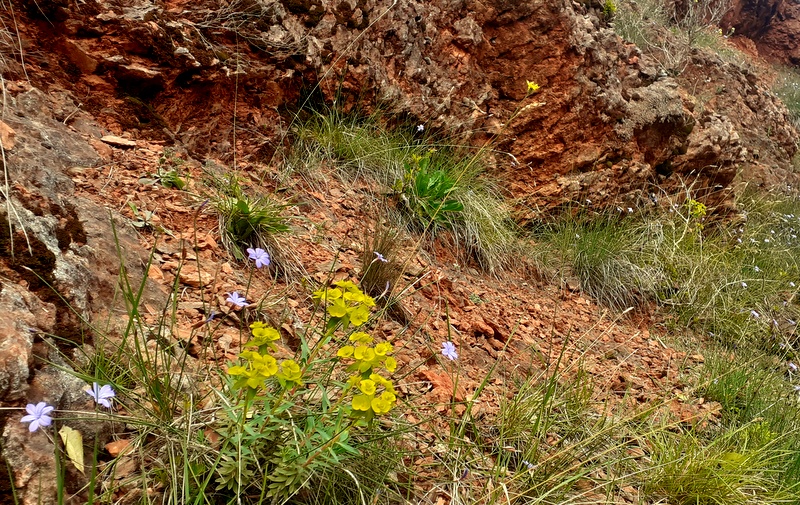
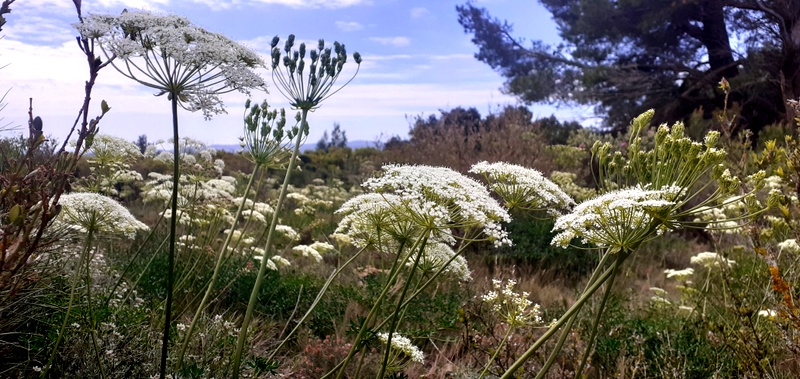
For now, Charlemagne’s imperial arse landing on the hill, or not, didn’t matter that much, we had launched. The hike was easy, quite pleasant, with no dramatically moving landscapes; yet the wooded shapes were enchanting. Composed by a blend of vegetation I would like to call garrigue, and grey stones in the far, when those stones didn’t turn red as if Colorado Springs’ Garden of Gods had traveled to me, the scenery was flying me between here and there. The sky’s color and those rocks under the grey sun had the exact same shades as my American road-trip, lights were twins and, if my naked arms reminded me I was in France, I enjoyed that memory of another me, of another piece of the the world I had touched with my eyes, feet and heart. I dived in my end of the world’s exploring mind pictures, the ones which call for me sometimes, like a sweet melancholia, but whose reunion whispers through distance are getting less demanding, reassured by the certainty of my return one day, when it is time.
But let’s go back to May’s present times, which, as a matter of fact, already belong to the past…
We wandered through Charlemagne’s hills’ red path, we stroked spring’s high weed, we bowed to Notre-Dame de Carla, the highest point of our voyage, and eventually, the sun broke through the wall of clouds to follow our return chats to Lagrasse which finally revealed, after some research, how Charlemagne’s arse had landed on that hill…
Mineral nugget shaped by the Orbieu River, the medieval town actually is one of the Imperator’s journeys’ many reminders and marks he left behind. Indeed, the place grew as the powerful Benedictine abbey was founded by Nimfridius, an important ecclesiastical dignitary of Carolingian Gaul, with Charlemagne authorization in 778. Honestly, architecturally speaking, I think the abbey tower is quite an eyesore (except if you are watching from afar, behind a tree and blinking), but eyesore or not, the abbey’s prosperity brought wealth to the famous town: Lagrasse.
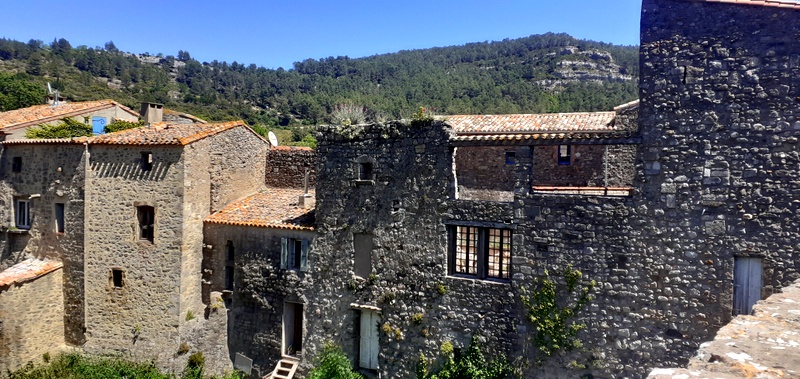
That trading place, mainly known by the handicraft sector, welcome in medieval times, the largest market in the Law Corbières, the market hall built is 1315 still testify for history.
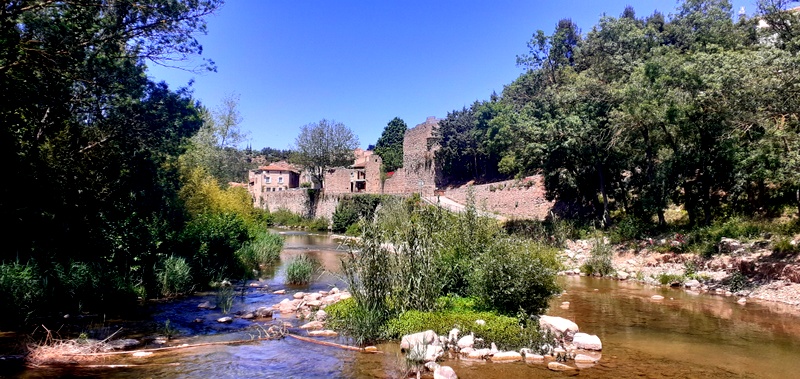
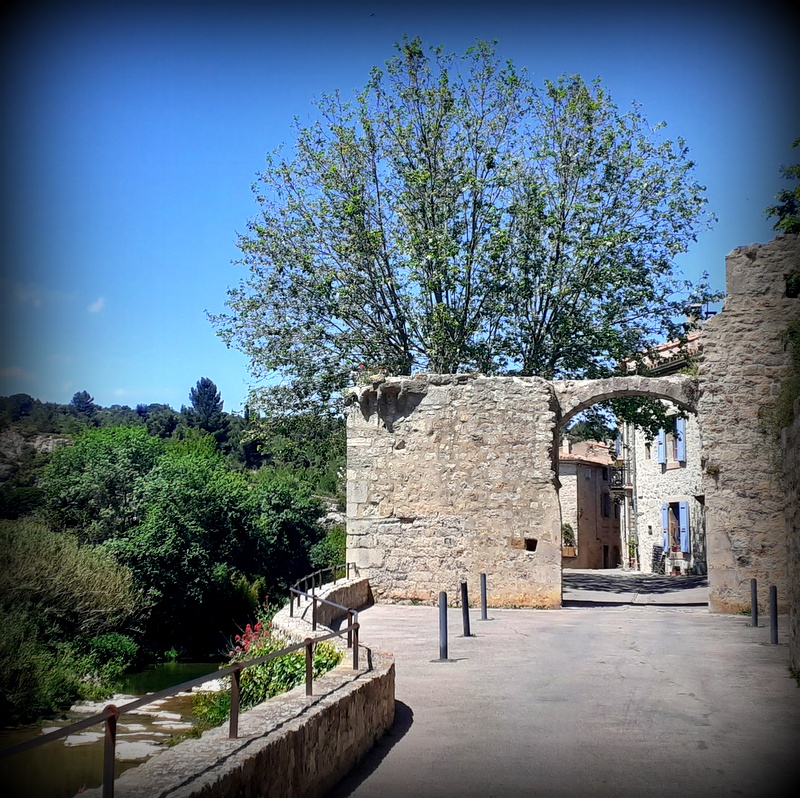
As for us, we gently winded through narrow streets after passing the Water Door, ancient walls’ only recall, and enjoyed the blooming simplicity of the place, ready to celebrate our day with an outdoor and happy hour pint. Sadly, we were one day early to go back to that missing habit. It was only May, 18th**…
As for you then? Without a mask and without reproach, without curfew nor authorization, go there led by your soul thirsty of beer like an early bird (a beer reward at noon works as well!) if you decide to visit during summer times: the walk is almost never shadowed, I therefore strongly recommend not to walk under noonday sun. To be honest, I invite you to discover that trail during mid-season to truly enjoy it. Be patient then: wait for September to finish summer in style and let adventures linger a bit after back-to-school times.
Until then, Cathar Land has other jewels for your thirst of adventures…
« Notre Dame de Carla » Trail’s description, a bit longer than “Charlemagne’s buttock”
Source : Visorando
10 km – around 3.45 hours
There are several car parks in Lagrasse, the closest to the departure is the P2, close to the gendarmerie. From the gendarmerie, take the main street towards the bridge over the Orbieu. Cross it.
Yellow and White marker
(km 0.26) At the intersection shortly after the bridge, leave the road to take the path that climbs into the forest, between the hiking signs. The trail rises on the forest crest. There is not much of a view on that portion.
(km 1.31) Pass close to a dry stone construction, the trail is more flat and the view opens a little more on the surrounding landscapes. Continue on this path another 1km.
(km 2.18) At the T-junction, turn right on the carriageway.
Yellow Markers
(km 2.57) At the intersection of 5 tracks, turn right, leave the GR® and continue on this path about 600m.
(km 3.17) At the cairn, leave the larger road to prefer a small path right into the vegetation. Follow this path near the edge of the cliffs and continues until you find a wide trail.
(km 4.17) Take this wide track on the right to reach Notre-Dame du Carla in 300m.
(km 4.43) Arriving at Notre-Dame du Carla, it is possible to go around and climb to the cross to enjoy a view of the Sou valley. Return to the intersection where you found the wide track on which you are progressing. Turn right onto this track one kilometre before returning to the GR® that follows a track. Take it on the left for 500m.
(km 5.96) At the next intersection, turn right onto the runway, continuing to follow the GR® markers and past a well. At the Lauza, turn left on a track covered by a vegetal tunnel.
Reach the intersection of the five paths encountered earlier (km 2.57) and take the same track to the T-junction (km 2.18), leave the GR® which turns left and continue descending the runway. At the end of a few ten meters, it is possible to cut by a small steep path on the right, it will join the drivable track below. Through the track, make two turns, to end up descending on the hillside. During the whole end of the descent enjoy the view of the village and the Abbey of Lagrasse. Pass between olive groves and vines.
(km 9.84) Continue straight at the intersection with the D41, the progression is now on a paved road, enter the village of Lagrasse, pass near the abbey.
(km 10.27) Follow the D41 to the old bridge to the right. Continue opposite to cross the village and reach the starting point.
* French expression : to be born from Jove’s thigh = to have a very good opinion of yourself
** The official French reopening of bars and restaurants after a long shutdown du to Covid-19 was May, 19th 2021.
 Fleeting Wor(l)ds